



Pastor Chris’ Tsion EVs: The Electric Cars, The Musk and Bezos Mystery, And What Comes Next

- August 20, 2026
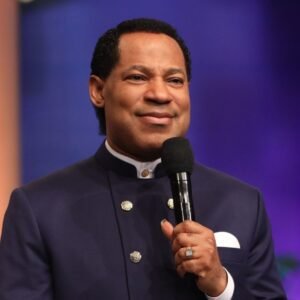
For a church known around the world for preaching, television, digital media and global evangelism, the sight was almost surreal. Pastor Chris Oyakhilome stood before a line of futuristic electric vehicles, walking his audience through a collection of cars carrying names such as Passion, Falcon, Vision, Vision Coupe and OG.
The brand behind them is Tsion. Suddenly, Christ Embassy was no longer being discussed only in the language of ministry. It was being discussed in the language of electric mobility, technology, innovation and the automobile industry.

The vehicles were unveiled during The New Economy Unveiling 2026 with Pastor Chris, an economic and innovation focused programme organized under the LoveWorld Global Fellowship. Videos from the event quickly circulated online, turning what happened inside the invitation only gathering into a much wider public conversation.
But while much of the immediate coverage has focused on the cars themselves, there is a more interesting story hiding behind the unveiling. What exactly is Tsion, and how far does Pastor Chris intend to take it?
ALSO READ:
More than one electric car
The first thing that stands out about the Tsion presentation is the breadth of the lineup. The vehicles shown included the Tsion Passion, Tsion Falcon, Vision models, Vision Coupe and the OG series. Pastor Chris also explained that OG means “Of God”, giving at least one part of the vehicle range a distinctly spiritual identity. That variety is significant.
This was not presented as a single experimental electric vehicle brought onto a stage to demonstrate that an organization had entered the EV conversation. There appeared to be an attempt to present an entire family of vehicles, with different identities and purposes.
There was also an admission that some details were still being refined. During the presentation, Oyakhilome pointed specifically to the steering wheel design as an element still undergoing development. That small detail may actually be more revealing than it first appears. It suggests that, despite the polished presentation and the number of vehicles displayed, the Tsion project may still be somewhere between unveiling, development and commercial readiness.
And that is where the real questions begin.

The Elon Musk and Jeff Bezos question
Perhaps the most intriguing moment surrounding the unveiling came when Pastor Chris acknowledged two of the biggest names in modern technology and business, Elon Musk and Jeff Bezos.
According to reports, Oyakhilome thanked Bezos and Musk during his address, saying Bezos had been helpful when they “got started on the Wall Street thing” and thanking Musk for what he described as his “personal attention.” He then suggested that there was more he was not yet ready to disclose, adding that people should wait until November.
That statement immediately created another story within the story. What exactly did Bezos contribute? What did Musk contribute? Was their involvement directly connected to the Tsion vehicles? Was it technical? Financial? Strategic? Advisory? Or was Oyakhilome referring to a broader economic and technological project being unveiled under the New Economy vision?
At this point, those questions should remain questions. There is not enough publicly verifiable information to claim that Elon Musk or Jeff Bezos helped design, finance or manufacture the Tsion vehicles.
What we can say is that Pastor Chris publicly acknowledged both men and indicated that their involvement or contribution would make more sense when further details are revealed. That makes November particularly interesting. Because if the promised revelations materialize, they could dramatically change how the Tsion story is understood.
The part nobody can confirm yet
There is another reason the Tsion unveiling deserves closer scrutiny. The cars may have been unveiled, but some of the most basic information a potential buyer would want remains unavailable.
There are currently no sufficiently established public specifications for the battery capacity, driving range, charging time, charging architecture or pricing of the models shown. There is also no clear public confirmation establishing the commercial launch date, production volumes or the exact manufacturing arrangement behind the vehicles. Pulse similarly noted that these technical and commercial details had not been disclosed.
That matters because unveiling a vehicle and successfully producing a vehicle are two very different stages of the automotive business. The first requires design, presentation and engineering. The second requires supply chains, battery systems, quality control, production facilities, regulatory approvals, trained technicians, spare parts, charging support and a sustainable business model.
Tsion will eventually have to answer all of those questions.
Is this actually a Nigerian electric car project?
This may become the most important question of all.
Several reports have described Christ Embassy’s move as an entry into automobile manufacturing or the automotive industry. Other reporting has been more cautious, describing it as a move into electric mobility and technology.
There is also footage circulating online that appears to show a manufacturing environment associated with the presentation, but the available reporting does not independently establish where that facility is located, who owns it, what percentage of the vehicles is produced locally, or whether Tsion has begun full scale commercial production.
Those distinctions are crucial. There is a world of difference between a vehicle being designed in Nigeria, assembled in Nigeria, partially manufactured in Nigeria, and completely manufactured in Nigeria with substantial local components.
If Tsion eventually establishes genuine local production, it could become a significant development for Nigeria’s automotive ambitions.
And the timing is particularly interesting.
Nigeria is actively trying to develop an electric vehicle ecosystem. In January 2026, the National Automotive Design and Development Council announced that the Federal Government had signed an MoU with South Korea’s Asia Economic Development Committee for an EV manufacturing plant and charging infrastructure. The stated plan includes an initial assembly phase followed by facilities capable of full in house production.
The government has also expanded the Presidential Initiative on Compressed Natural Gas to include electric vehicles, giving the programme responsibility for coordinating EV deployment, charging infrastructure and related investments.
In other words, Tsion has arrived at a moment when Nigeria itself is beginning to position electric mobility as part of its industrial future.
But Nigeria has a difficult EV problem
The opportunity is enormous. So is the challenge.
Nigeria’s electric vehicle transition is being pushed forward by government incentives and private sector investment, but the country’s electricity infrastructure remains one of the biggest obstacles to widespread adoption.
Reuters reported in August 2026 that Nigeria’s electricity system was delivering around 4,000 megawatts for a population of more than 200 million people, while public charging infrastructure remained limited. EV users therefore often depend on home charging or alternative systems.
That means Tsion’s success will not depend solely on whether the cars look good. It will depend on whether the ecosystem around them works.
Can a Nigerian owner charge the vehicle reliably? What happens when the battery develops a fault? Where will replacement parts come from? Who will service the vehicles? How much will a replacement battery cost? Will Tsion build its own charging network?
And perhaps the question that will determine everything else, How much will these cars cost?
Until those questions are answered, it is too early to know whether Tsion is about to become a serious automobile company or whether this unveiling represents the opening chapter of a much longer technological project.
The church has already shown it understands technology
There is another reason the Tsion project should not be dismissed as a publicity stunt simply because it comes from a religious organization. Christ Embassy has long used technology as a means of extending its global reach, particularly through broadcasting, digital platforms and online communication.
The New Economy programme appears to take that technological orientation into a very different territory, with reporting around the event pointing to a wider vision involving technology, finance, artificial intelligence and digital platforms in addition to electric mobility.
Tsion therefore appears to be part of something broader. The cars may be the most visually striking part of the announcement, but they may not be the entire story.
Pastor Bolaji Idowu sees something bigger
Pastor Bolaji Idowu, founder of Harvesters International Christian Centre, appeared to understand the significance of the moment immediately.
Reacting to the unveiling, he described the development as evidence that the church could demonstrate its influence in the marketplace. “My mind has been stretched,” Idowu said. “This is what it means to be the salt of the earth and the light of the world.”
He continued by arguing that the church should not simply wait for others to provide solutions, saying that it had a role to play beyond preaching. His reaction captures why the Tsion story has generated so much interest.
This is not only about electric cars. It is about the possibility of a religious organization attempting to build something that exists in the marketplace rather than only inside the church.
That is a much bigger conversation, and it deserves its own examination.
The real test begins after the unveiling
For now, Tsion has achieved something important. It has made people look. The vehicles are visually striking. The lineup is ambitious. The branding is distinctive. The involvement suggested by Pastor Chris’s comments about Musk and Bezos has added another layer of intrigue.
But attention is not the same thing as traction. The real test will begin when the cameras are gone. When the first customer wants to buy one. When the first battery needs replacing. When the first software update is required. When the first charging station has to be built. When the first production target has to be met. When the first vehicle has to compete against established global brands on Nigerian roads.
That is when Tsion will move from an impressive unveiling to an actual automobile business. And perhaps that is why the most important date from the entire presentation may not have been August 2026 at all.
It may be November. Pastor Chris has indicated that more will be revealed then. If those revelations clarify the technology, partnerships, manufacturing structure and broader economic vision behind Tsion, Nigerians may finally understand what they were looking at when those electric cars rolled onto the stage.
For now, one thing is clear. Pastor Chris did not simply unveil a collection of electric cars. He opened the door to a much bigger question about what Christ Embassy intends to build in the new economy.
And that story has only just begun.
MORE ARTICLES:
Jerry Eze Foundation Gives ₦1 Billion in Grants to 240 Nigerian Entrepreneurs: No Loan, No Collateral
Adekunle Gold Foundation Provides Care for 400 Sickle Cell Patients in Lagos

Desauce Magazine is more than a blog, it is a cultural journal capturing the rhythm of Nigeria. From music and film to lifestyle and social issues, we tell stories that reflect the energy, struggles, and brilliance of our people.