It was meant to be a quiet Easter Sunday in Jos, a day marked by worship, family gatherings, and reflection. By nightfall, that sense of calm had given way to fear, confusion, and another round of tragedy that has once again placed Plateau State at the centre of Nigeria’s insecurity debate.
In Angwan Rukuba, a community in Jos North, residents say the evening began normally. People were still outside, shops were closing, and families were settling in after Easter activities. There was no clear warning of what was about to unfold.
Then came the gunfire.
According to multiple resident accounts referenced in early reports, shots were first heard around 7.30pm. At first, some people mistook it for isolated violence or a local dispute. Within moments, that assumption collapsed as the sound intensified and spread across parts of the community.
Panic followed almost immediately. Residents ran in different directions, children were pulled indoors, and doors were locked in haste. Those who were outside described a rapid breakdown of normal life into chaos, with visibility low and confusion spreading as people tried to understand where the danger was coming from.
In the absence of clarity, survival became instinct. Families fled into nearby streets and adjoining compounds. Some residents said they did not stop moving until they reached areas they believed were safer, unable to confirm what was happening behind them.
By the time the shooting subsided, the damage had already been done. Reports from local sources and early official briefings indicate that multiple people were killed and several others injured. The exact number has varied across updates, but authorities have confirmed a significant loss of life.
As dawn approached, the community began the painful process of accounting for those missing. Residents moved cautiously through affected areas, calling out names and searching for relatives. It was during this phase that the full scale of the tragedy began to emerge, as bodies were discovered and families confronted the reality of what had taken place overnight.
Emergency responders and security personnel were later deployed to the area, and survivors were taken to nearby medical facilities, including the Jos University Teaching Hospital, where medical teams treated the injured. Hospital sources described a sudden influx of casualties that stretched response capacity within the first hours of the morning.
ALSO READ:
In the aftermath, grief quickly spread through Angwan Rukuba and surrounding communities. For many residents, the shock was not only in the violence itself, but in its timing, coming during a sacred Christian period when families traditionally gather in peace. The attack added another layer of emotional weight to an already fragile environment.
Meanwhile, Governor Caleb Mutfwang addressed the state in a broadcast following the incident, expressing sorrow over what he described as a deeply painful loss of innocent lives. He insisted that the state would not be subdued by fear or intimidation, stating that Plateau State would “emerge stronger, united, and resolute in our commitment to peace.”
He confirmed that security agencies had been mobilised and that a 48 hour curfew had been imposed in Jos North to stabilise the situation and support ongoing operations. The governor also stated that a suspect had been arrested in connection with the attack, while assuring that medical costs for the injured would be covered by the state government.
He further visited victims receiving treatment at the Jos University Teaching Hospital, where he said most were in stable condition, and pledged support for affected families, including assistance with burials and welfare for dependents. Commending residents for not engaging in retaliation, he described their restraint as important in preventing further escalation.
As authorities continue investigations, questions remain over the exact circumstances and motive behind the attack. No group has claimed responsibility, and security agencies have yet to release a full account of the perpetrators.
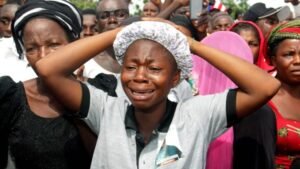
In the days following the incident, distressing videos began circulating online showing grieving families in the aftermath of the violence. One widely shared clip shows a woman in deep distress over a young victim, though the origin, timing, and context of the footage have not been independently verified by official sources. Authorities have not issued confirmation regarding the video, but its circulation has intensified public emotion and renewed attention on the human cost of recurring violence in the region.
For many in Jos, however, the incident is not viewed in isolation. It sits within a long and painful pattern of violence in Plateau State, where disputes over land, identity, and community relations have repeatedly erupted into deadly confrontations. Residents describe a cycle that often begins suddenly, unfolds quickly, and leaves lasting scars long after security forces restore order.
What remains after Easter Sunday is not only a body count, but a familiar sense of uncertainty. Families are left grieving, communities are left anxious, and authorities are left responding to yet another eruption in a region where peace often feels fragile and temporary.
And once again, the same question lingers across Jos in the aftermath of the silence that follows gunfire, how long before it happens again.