



- May 9, 2026

Nobody Saw This Coming. And Yet It Feels Like It Was Always Supposed to Happen.
Let me be honest with you. When I heard Burna Boy was doing the FIFA 2026 World Cup anthem alongside Shakira, my first reaction wasn’t excitement. It was something closer to disbelief that quiet, electric kind of disbelief you get when history taps you on the shoulder and says pay attention.
Because this isn’t just a song announcement. It’s a statement. It’s a line being drawn in the sand between what football music used to look like and what it looks like now. And right in the middle of it, holding his ground like he was born for the moment, is a kid from Port Harcourt who grew up on reggae, dancehall, and stories of survival.

That’s not normal. That’s legacy being written in real time.
ALSO READ:
Burna Boy’s No Sign of Weakness Is Not Just Music, It’s a Global Declaration
Burna Boy Breaks New Ground as Billboard France’s First-Ever Cover Star
What World Cup Songs Actually Do to People
Here’s the thing most people don’t fully appreciate about FIFA anthems, they’re not just music. They’re time machines.
Hear Ricky Martin’s “Cup of Life” and you’re suddenly back in 1998, watching football explode through a television screen with that unmistakable burst of energy that made you feel like the sport itself had a heartbeat. K’naan’s “Wavin’ Flag” carries something heavier hope, resilience, the kind of emotion that sneaks up on you fifteen years later in the middle of an ordinary Tuesday.
And then there’s “Waka Waka.”
Shakira didn’t just make a World Cup song in 2010. She made the World Cup song. The one that jumped out of stadiums and into living rooms, schoolyards, wedding receptions, and the memories of an entire generation. Even people who couldn’t name a single footballer know every single word of that song. That’s not a hit. That’s cultural religion.
So when you hear that Burna Boy is sharing the stage with her the woman behind arguably the most iconic football anthem of the modern era you understand immediately what the stakes are. This isn’t a feature. This is an inheritance.
Afrobeats Was Already There. You Just Weren’t Paying Attention.
Let’s not pretend this came from nowhere.
Football and Afrobeats have been quietly building something together for years, mostly out of sight of the people writing the official narratives. Walk into a dressing room after a big victory and Afrobeats is already playing. Scroll through football edits on TikTok the ones with millions of views, the ones that actually feel like football and it’s Burna, Rema, Davido, Wizkid, Asake soundtracking the whole thing. Watch players lift trophies and somewhere in the crowd, somebody is dancing to an African record.
The tunnel music changed. The stadium playlists shifted. The warm-up sessions, the fan edits, the travel vlogs Afrobeats didn’t storm into football culture. It moved in quietly, made itself comfortable, and by the time anyone thought to formally acknowledge it, the music was already home.
So the Burna Boy FIFA World Cup anthem doesn’t feel random. It feels inevitable. Like catching up to something that already happened.
Why Burna Boy Specifically Makes Sense in Ways That Are Hard to Explain
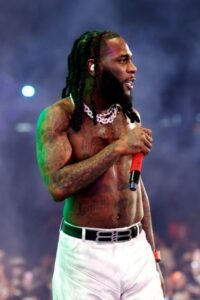
Not every artist could carry this.
FIFA anthems demand a very specific kind of music. It has to feel massive without feeling empty. It has to carry emotion without becoming generic. It has to work blasting through stadium speakers at full volume and still feel intimate enough that someone hums it alone on their commute two months later.
Burna Boy’s catalogue already does this. His records don’t sound like they were made for headphones. Songs like “Ye,” “Anybody,” and “Last Last” feel communal in a way that’s almost physical like music that was designed to echo through large spaces, through crowds, through shared human moments. There’s always this underlying tension in his sound, this sense of celebration pressed right up against survival. Joy that knows what it cost.
That’s exactly the emotional frequency a World Cup anthem needs to hit.
He’s also entering this differently than African artists who came before him in these kinds of global moments. He’s not auditioning. He’s not hoping to be taken seriously. Burna Boy is already selling out stadiums on multiple continents. FIFA didn’t offer him a favour FIFA needed what he brings.
That shift in power is the most interesting thing happening underneath this announcement.
“Dai Dai” and the Weight of What Comes Next
Here’s the real question nobody wants to sit with too long.
Can this song become timeless?
Most World Cup anthems don’t survive the tournament. They get played relentlessly for a month, maybe two, and then they become trivia answers. Only a handful and we’re talking a handful cross over into something permanent. Songs that people reach for years later not because they’re trying to remember football, but because the music itself holds something they don’t want to let go of.
“Dai Dai” is carrying real pressure. The combination of Burna’s global reach and Shakira’s unmatched FIFA legacy means expectations aren’t just high they’re architectural. People will listen for the first time with “Waka Waka” already in their heads. That’s an unfair comparison and it will happen anyway.
But maybe that’s also what makes this moment so compelling to watch unfold. Because if Burna Boy and Shakira pull it off if “Dai Dai” becomes that song for the generation growing up right now it won’t just be a great World Cup anthem.
It’ll be proof that Afrobeats doesn’t need football’s permission anymore. It is football now. And it has been for a while. We’re just finally catching up to what was already true.
A boy from Port Harcourt. Beside the woman behind “Waka Waka.” On the biggest sporting stage on earth.
Tell me that doesn’t mean something.

Desauce Magazine is more than a blog, it is a cultural journal capturing the rhythm of Nigeria. From music and film to lifestyle and social issues, we tell stories that reflect the energy, struggles, and brilliance of our people.