



Violence in South Africa over alleged Igbo King Coronation

- March 31, 2026
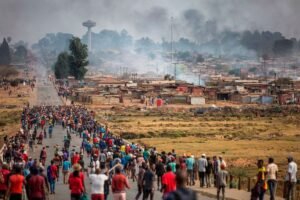
A wave of violence in South Africa has been linked to reports of an “Igbo king coronation” in Eastern Cape.
But the truth is more layered than the headlines suggest.
What was likely a cultural leadership event within the Igbo community was interpreted as a foreign claim to traditional authority, triggering outrage.
The result, protests that spiraled into violence, exposing deeper issues around identity, sovereignty, and long-standing xenophobia.
Sometimes, it’s not guns or politics that start a crisis. Sometimes, it’s a word. In this case, that word was “king.”

What should have been a quiet cultural moment within a diaspora community quickly turned into a national flashpoint. Streets tense, businesses attacked, communities divided, all because two groups heard the same thing and understood it in completely different ways.
This is not just a story about violence. It is a story about misunderstanding, history, and the fragile balance between culture and territory
WHAT TRIGGERED THE VIOLENCE
The crisis began in Eastern Cape, South Africa, around KuGompo, East London.
Reports surfaced claiming that a Nigerian, identified as an Igbo community leader had been “coronated” or installed as a king”
That single narrative spread fast, and it immediately raised alarm. It did not sit well with Local South African residents, Traditional leaders
and Political groups like ActionSA
The reaction was immediate and emotional. In South Africa, traditional leadership is not symbolic or casual. It is deeply tied to land
rooted in indigenous identity and protected and regulated by law. So, the idea of a foreigner being “crowned king” felt, to many, like a direct challenge to that system.
WHY PEOPLE GOT ANGRY
The backlash didn’t come from one place. It came from three powerful tensions colliding at once. For many locals, the question was simple, but loaded: “How can a foreigner be crowned king on our land?”
Political voices argued that: It violates constitutional and traditional systems and there is no legal framework that allows such recognition.
To them, this was not culture, it was overreach.
This is where things get complicated. What Nigerians, especially the Igbo diaspora, refer to as: Eze Ndigbo …was interpreted very differently.
Within the Igbo community: It means a cultural leader, a community head, a representative of Igbo people abroad.
But to many South Africans, the word “king” means:, A sovereign ruler, Someone with authority over land and people
That difference in meaning created a dangerous misunderstanding.
Let’s not pretend this started here as South Africa has a history of: Anti-foreigner violence, Economic resentment toward immigrants and Periodic xenophobic attacks.
Nigerians, often visible in business and trade, have frequently been targets. So this incident didn’t create tension.
It activated tension that was already there.
WHAT ACTUALLY HAPPENED DURING THE VIOLENCE
What began as protest didn’t stay that way. Events escalated quickly. Demonstrations turned aggressive leading to vehicles being burnt, Shops, especially foreign-owned businesses, were looted and attacked
There were Clashes between protesters and police and several people were injured
There were also reports of a stabbing incident and retaliatory attacks that deepened the chaos.
Security forces had to intervene to regain control, but by then, damage had already been done.
NIGERIA’S OFFICIAL RESPONSE
Then came a major twist. The Nigerian High Commission in South Africa stepped in and denied the core claim.
According to them: No king was coronated, the event was simply a cultural gathering or festival.
They also Issued safety advisories, Urged Nigerians to stay cautious and avoid unnecessary exposure
This response reframed everything.
If there was no coronation, then what triggered the violence was not an action, but a perception.
WHAT “EZE NDIGBO” ACTUALLY MEANS
In Igbo culture, Eze Ndigbo translates to: “King of the Igbo people” But outside Nigeria, that title does not function as literal kingship.
It does not Control land, govern non-Igbo communities or compete with local traditional rulers
Instead, it operates as a community chairman, a cultural custodian or A spokesperson for the Igbo diaspora
Think of it as a structured leadership role within a community, expressed through traditional language.
WHY IGBO COMMUNITIES CREATE THIS ROLE ABROAD
Igbo communities are known for strong organization, especially in diaspora settings.
Wherever they settle, they build structure. The Eze Ndigbo role helps to resolve internal disputes, represent the community in official matters, preserve culture and traditions and Organize welfare systems and festivals among other functions.
In countries like South Africa, The United States and parts of Europe, it serves as internal governance, not external authority.
WHERE THE CONFUSION HAPPENS
The crisis sits in a gap between two interpretations.
Igbo understanding, Eze” is symbolic and Authority is cultural and internal
South African understanding, “King” is sovereign and Authority is territorial and legally recognized.
In a country where traditional leadership is formal, protected, and tied to land, that misunderstanding was explosive.
HOW KINGSHIP WORKS IN SOUTH AFRICA
Traditional leadership in South Africa is: Legally defined, linked to indigenous ethnic groups like Zulu and Xhosa, embedded in governance structures.
Kings are not just cultural figures. They are part of the institutional identity of the nation.
So, when people heard “An Igbo man was crowned king”, it sounded like foreign claim to local authority, a disruption of established systems.
That perception triggered resistance.
WHAT LIKELY HAPPENED
Looking at all available information, the most realistic scenario is A cultural event or leadership recognition took place. Possibly involving an Eze Ndigbo title within the Igbo community. The event was misinterpreted or misreported as a coronation of a king
That misunderstanding spread quickly, in a region already dealing with economic pressure, immigration concerns and social tension, it ignited.
THE REAL ISSUE BEHIND THE HEADLINES
It is about, Identity, Ownership of culture and land, Immigration pressure and communication gaps between communities
A single word carried two meanings, and those meanings collided in real life.
CURRENT SITUATION
Authorities in South Africa are calling for calm as they are working to stabilize affected areas. The situation remains tense but controlled.
Nigerians in the region have been advised to stay alert, avoid gatherings and to prioritize safety.
Bola Ahmed Tinubu Addresses Nation Over Ongoing Protests
How Updated Are You on Nigeria’s Gist Today?
“Nigeria Leads Africa’s Diagnostic Future as Codix Bio Expands Test Kit Production”

Desauce Magazine is more than a blog, it is a cultural journal capturing the rhythm of Nigeria. From music and film to lifestyle and social issues, we tell stories that reflect the energy, struggles, and brilliance of our people.